| The Battle | The Names | Links |
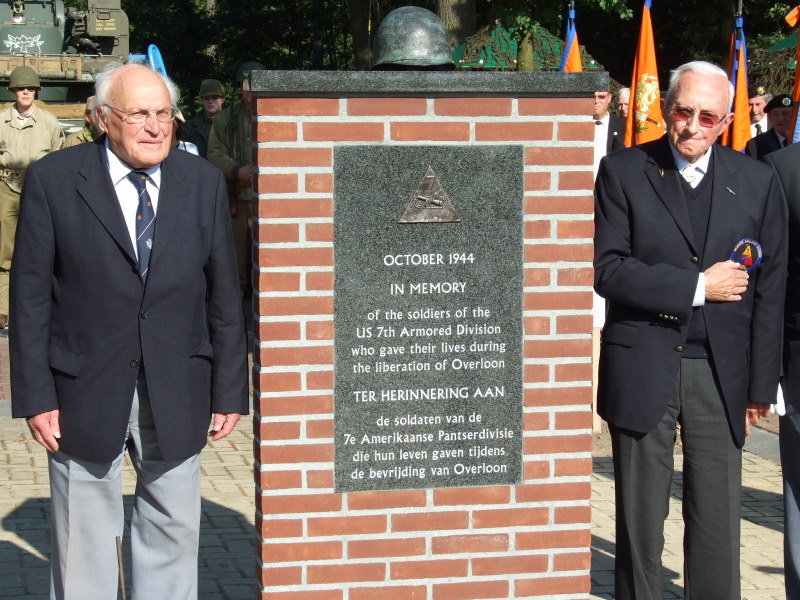 7AD Dutch veterans Hans Jansen (left) and Albert van Leeuwen immediately after unveiling the 7AD monument in the Liberty Park at Overloon. (2008) (photo thanks to Kees Stravers) |
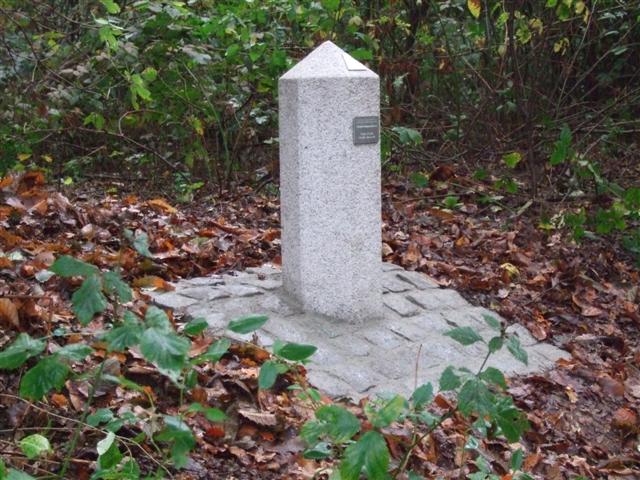 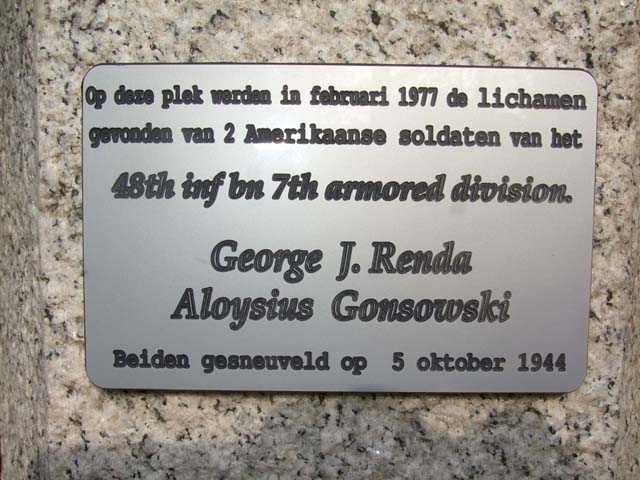 Monument to 7AD men killed along Kamphoefweg, just west of Overloon (photos thanks to Sieb Wilmsen, who found their remains in 1977 and erected the monument in 2009) |
 Gen. Hasbroucklaan (General Hasbrouck Lane) in Overloon Gen. Robert Hasbrouck commanded 7AD's Combat Command B during the battle and later became commander of the Division. (photo thanks to the Henckens family of Overloon and Niek Hendrix of Ospel, Netherlands) |
|
The complex battle for Overloon (and Venray and Venlo, to clear the Maas Salient) defies adequate description in a few words. Nevertheless, this simplified version gives some sense of the context, the issues involved, and the nature of the battle. Events Leading up to the Battle In September 1944, Allied forces made two divergent pushes, which left a significant German salient that threatened the flanks of both Allied forces. On the west and north, British ground and airborne and American airborne divisions had, in Operation Market-Garden, driven north from Belgium into the Netherlands, almost as far as Arnhem. On the east and south, American ground forces had driven into Germany and succeeded in taking the first major city in Germany, Aachen. But the German forces, in a salient west of the Maas River, between these two Allied forces had to be dealt with. The greatest threat was to the right flank of the Operation Market-Garden corridor. While this was all going on, the U.S. 7th Armored Division was heavily engaged in combat far away, just south of Metz, France, suffering heavy losses. Nevertheless, it was 7th Armored Division that was called upon to do the job in the Netherlands. On 25 September, the Division began the two-day journey north to the area of Belgium just west of Maastricht. They had just enough time to fill their losses with brand new replacements -- many of whom would be casualties within a bit more than a week. They had no time to integrate these new men into their ranks nor to do anything more than deal with the move to a distant new area and deal with the realities of fitting into a new command and supply structure while on the move. The Two-Division Battle Plan The 7th Armored Division was rushed into position for an attack originally planned as a 2-division attack, along with U.S. 29th Infantry Division. However, First U.S. Army Commanding General Courtney Hodges made the decision to send in the 7th Armored Division alone, choosing to use the 29th Infantry Division to protect his open left (north flank) instead. Gen. Hodges' optimism that the Maas Salient could be cleared by only one division proved fatal to many men of 7th Armored Division, as well as one member of the supporting non-divisional 82nd Engineer Combat Battalion, and a fighter pilot of the 389th Fighter Squadron (366th Fighter Group). To quote Charles B. MacDonald ("The Siegfried Line Campaign", p. 233), "so optimistic was General Hodges ... that he seriously considered that the 7th Armored Division's operation west of the Maas might prove unnecessary." It seems, in fact, that Gen. Hodges did not really think that the Maas Salient would be a problem at all but rather woud be bypassed. It seems likely that Gen. Hodges' optimism was based on the XIX Corps G-2 report, which estimated that the entire Maas Salient held only 2,000-3,000 Germans troops, when in fact there were 7 to 8 times as many German troops there. Forced to Attack Based on Outdated Intelligence 7th Armored Division Commanding General Lindsey M. Sylvester tried to carry forward with Gen. Hodges' optimism and make the best of a bad situation, but the harsh reality of the situation would soon demolish all wishful thinking and cost many lives. There was apparently no opportunity for 7th Armored Division's 87th Cavalry Reconnaissance Squadron to scout out the area where 7th Armored Division would attack -- scouting that probably would have revealed the far greater German strength than the XIX Corps G-2 had told Gen. Sylvester to expect. The only intelligence available was from British forces who had been in contact with the Germans. However, the British broke off contact days before the arrival of the Americans. The Germans took great advantage of the British gift and built up strong defenses at Overloon, defenses that British intelligence knew nothing about. As a result, Gen. Sylvester went into battle with faulty outdated intelligence that said the Germans were on the run. The Battle Begins On the morning of 29 September 1944, hardly any member of the U.S. 7th Armored Division had yet been in the Netherlands. The 7th Armored Division attack was launched the afternoon of 30 September. But when 30 September dawned, the division and the eight men who would die from that day's combat near Overloon were still 15-20 miles away from the attack's line of departure. In spite of being thrust alone in a planned 2-division attack in terrain that they had not even seen until a few short hours before the attack, 7th Armored Division did far better than one would expect, despite the many reasons that failure to take Overloon was almost inevitable. The Division attacked on a broad front, despite having only 3 infantry battalions. And it was infantry that was needed for this battle. The open fields and soggy marshy terrain, with occasional dense woods, kept tanks on the roads and made them easy targets. So it was the infantry that had to make the progress, while numerous tanks were destroyed. But 3 infantry battalions -- trying to do what had originally been planned for an entire infantry division -- was far from adequate to overcome the German defenses. They did drive the Germans south a few miles to the very outskirts of Overloon, but there the battle became a stalemate, more reminiscent of World War I battles of attrition through attacks and counter-attacks that went on and on but failed to change the front lines. Reality Finally Demolishes Wishful Thinking Finally, the hopelessness of the situation, the over-optimism of Gen. Hodges, became brutally obvious. So it was decided that the 7th Armored Division would be relieved by British troops, who would then press the attack forward from the outskirts of the town to take the town itself. In place of every American soldier in the battle, there were now four British soldiers. And still the British had a very difficult time. They took Overloon the first day of their attack (12 October -- the attack had to be delayed due to very heavy rains, making the ground all the more impassable to tanks), but they the British then found themselves in a position very similar to where 7th Armored Division had been at the start of the battle for Overloon: the British now had to deal with the same woods and open ground, as well as a stream, as they sought to drive from Overloon to Venray. And even though their force was four times larger than the 7th Armored Division, they also took several days to drive to the outskirts of Venray. So what 7th Armored had tried to do as one division of only 3 infantry battalions, the British achieved (with only slightly better results) with a force of 3 divisions (one infantry, two armored) of 12 infantry battalions, plus two armored brigades -- roughly 4 times as many men and far more specialized armored vehicles. In that light, the accomplishments of 7th Armored Division are quite remarkable. Understanding the Battle in Full Context When taken out of context as the isolated engagement of two military forces, the 7th Armored Division failed to take Overloon. However, when viewed within the full context of the events, 7th Armored Division made the best of a very bad situation and provided the needed buffer to keep the German forces from attacking the right flank of the salient created by Operation Market-Garden, thus allowing the British to bring full force to the effort to clear the Germans from the estuary of the Schelde River and clear the approaches to the critically important port of Antwerp. This cost 7th Armored Division greatly, as the following section shows. |
The following compilation was made by 7th Armored Division Association Historian, Wesley Johnston. A great deal of information on the more difficult cases was made available thanks to the efforts of Joost Evertsen of Utrecht. And much of the detail of the locations and local information was provided by Piet Peters of Overloon. Hans van Toer of Heitrak provided similar aid in the eastern area of the battle. This work was also made vastly easier thanks to the high resolution scans of the 1:25,000 WWII grid map of the area provided by Wilco Krul of Eindhoven. An important part of the research by Wesley Johnston relied heavily on the 7th Armored Division Morning Reports, and thanks are owed to Brittany Sola and Melissa Mederos of the staff of Congressman Devin Nunes for their help in obtaining those critically important records. Thanks also to Ed Husted, Historian of the 82nd Engineer Combat Battalion. Thanks also to Ted Darcy of the WFI Research Group for helping to determine whether the last few names that needed to be included or eliminated. And, last but certainly not least, Niek Hendrix of Ospel provided the driving force that has raised the level of interest and awareness of what really happened in the battles of WWII in this area of the Netherlands.
Here are the names of the American soldiers who died in this battle or died later as a result of this battle, either dieing of wounds suffered in the battle or dieing as a prisoner or war captured in the battle. There are two known additional Americans, probably airmen, whose remains were recovered from Beugen and Venray, who may belong on this list as well, but thus far no further information -- including their correct names -- has been found. Despite intense and diligent efforts, the state of the records of WWII is such that there are very likely other men who will later be discovered to have died in the battle, whose names will have to be added.
There are 131 men listed here. 129 of these are men of 7th Armored Division. One (Sanders) is from the 82nd Engineer Combat Battalion. And one (Grounds) is from the 389th Fighter Squadron (366th Fighter Group). All 131 men are listed alphabetically.
|
Infantry-90 48 AIB - 51 38 AIB - 23 23 AIB - 16 |
Tank-30 17 Tank - 15 40 Tank - 8 31 Tank - 7 |
Engineer-5 33 AEB - 4 82 ECB - 1 |
Cavalry-4 87 CRS - 4 |
Artillery-1 440 AFAB - 1 |
Air-1 389 FS - 1 |
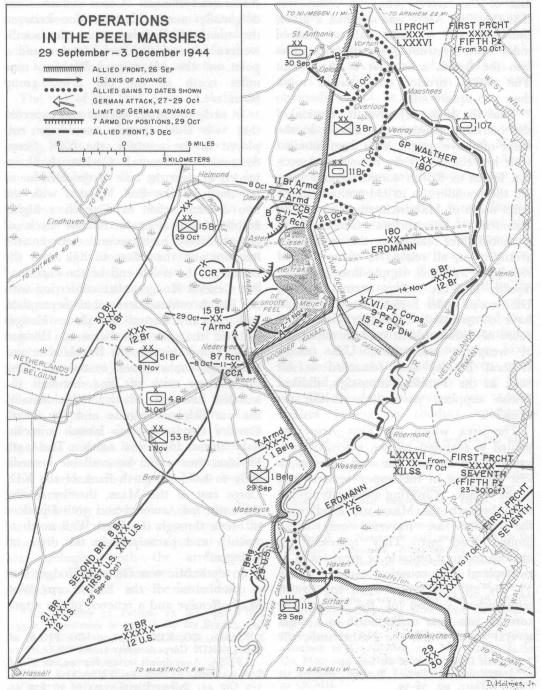 - Click on the map for a larger version.
Active overview of all pages at the 7th Armored Division web site